Have an Ancestor Encounter!

Saturday, October 1, 2022

Hidden family history treasures in the attic

Cleaning out old boxes in my attic recently allowed me time to reflect on my life as I sorted old photos and documents attempting to distill them down to the most meaningful.  I digitized family history items for genealogy research and passed them on to descendants, sent VHS tapes out for transfer to create easy-to-use viewing files, and found my old writing from college.  In 1975 I was just finding myself and was asked to reflect on a significant place.  As I spend so much time getting to know ancestors from the past, it was meaningful to also connect with my young self. The sentiments I wrote all those years ago are still important to my mature self and were a gift...

In all my travels from Florida to Maine and west to Seattle, my very favorite place is a small wooden pier at our ancestral property in Maryland. At the end of the narrow, grey, warped dock are two ladders for climbing in and out of boats and I curl up around the extending posts, dangling my feet which just miss the crests of passing waves. 

I love to sit there all alone and think or cry or sing but mostly pray. It's easy to become close to God there because His beautiful works envelop me. If I don't look back to land it feels like I'm completely surrounded by water. Boats go by that pier all day in the summer to get from the secure marinas on the creek into the Chesapeake. I especially loved the sailboats with colored sails that whipped wildly as the boats rounded the stone jetty and headed for deep water. Whitecaps would crash into the rocks shooting spray and seaweed. The opposite shore looks like a Mediterranean dream, with narrow winding streets climbing up a hill and close-set white houses hugging the land. 

The pier runs parallel to a long stone jetty that separates the mouth of our wide creek from the white-capped swells of the Chesapeake Bay. At sunset, the blues, golds, and pinks of the sky reflect on the rolling water and lights appear from boats and houses that twinkle like stars. I could sit on those old rotting boards forever, but mosquitos or a chilling wind, or a voice from the house calls me back to land and away from my special place.  

Teachers over the years would ask for essays about a favorite place and I always wrote about the peace of sitting on that pier feeling close to nature, watching the sunsets, and praying. Many times, I have gone back to visit and never leave without a walk to the pier which is where I established a relationship with God and go back to reconnect.

View from my Pier at Cedar Point on the Chesapeake Bay

Monday, August 22, 2022

When History goes up in Smoke

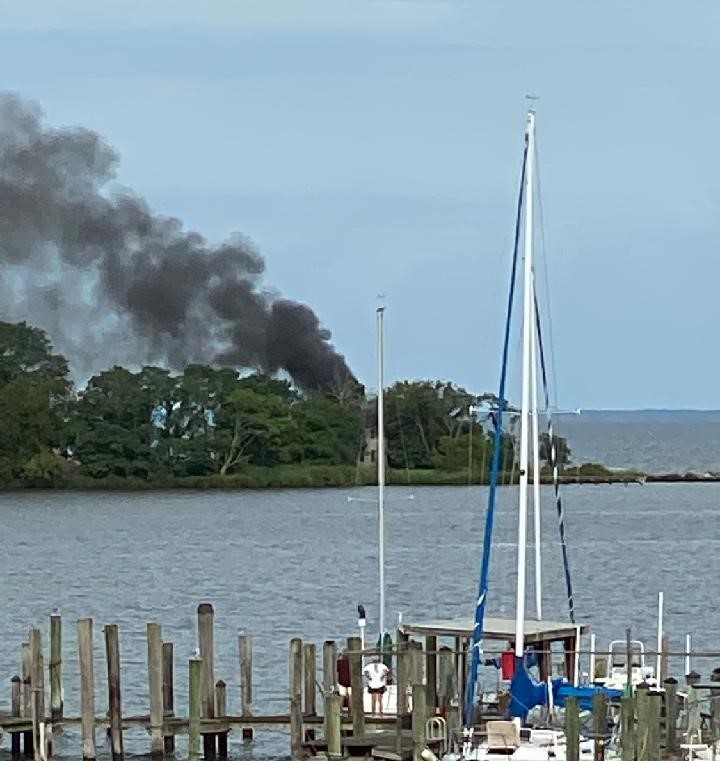
At 5:34 pm last night my phone lit up with the message "your house is on fire." My heart stopped, I opened the attached picture and started to cry. I knew the sender of the message who now lives in Texas and recognized the picture, not of the house where I was eating dinner, but the site of my ancestral home I sold several years ago. It was on fire. Friends saw the black smoke rising over the trees, realized the location, and took out their phones for photos.  The pictures bounced from Maryland to Texas to Pennsylvania to New York and then Washington State. Calls, emails, and more texts poured in throughout the evening as my children and old family friends realized I would feel profound sadness as a part of my family history was destroyed.  I soaked up all the bits of news as the flames were put out so many miles away.
Fire in Deale, Maryland 21 August 2022 - Kathleen Flanagan


Sorrow swept through the family as one by one we realized that the home our family had owned for 100 years was in crisis. Gratitude that the members of the family who have passed away would be spared today's trauma overshadowed the regrets that the vessel of the memories of so many family events was disappearing. The gabled house on the point of land where Rockhold Creek merges with Herring Bay has stood guard since 1850 and through the thoughtless actions of teens on a lark was to be no more.

House at Cedar Point in flames - Knopps
                
We are so grateful for the Herculean efforts of the volunteer fire department who had over the years many times visited the property to rescue weekend sailors who had crashed their boats on the rocks coming back into port, and once in 1957 when my great grandfather, fighting dementia, had wandered out in a snowstorm and was lost. But last night those brave firefighters poured water on the old attic trying to diminish the flames and then searched for hot spots until dusk.

Aftermath - Kathleen Flanagan
  
As we honor our family's heritage in this age of climate change, natural catastrophes, and sometimes deliberate damage, it is important to document with story and photos the artifacts and properties of our ancestors to savor all that they have meant to our family and share with those yet to come.


House shell from the water - Peggy L'Hommedieu


Tonight I am reminded that community comes together to mourn the loss of history and support, even virtually, during times when others feel loss. I researched the property over the years, lectured on the history of the area, published a BOOKLET sold by the local Historical Society, and crafted house history essays in this blog. Now my EULOGY for a house is truly a sad song saying goodbye to a piece of history that last night went up in smoke.

House at Cedar Point, 1919 - Ella Roberts


Monday, August 1, 2022

A Serendipitous Genealogy discovery


Sometimes the most important documents, photos, or artifacts in our family history come to us from distant family who kindly passes on wonderful treasures like the family bible or a photo of a long-lost relative.  As the extended family all know that I have a passion for genealogy, often envelopes or boxes of items get passed on to the nutty family historian.  Sometimes the treasures are right under our noses, and we had them all along.


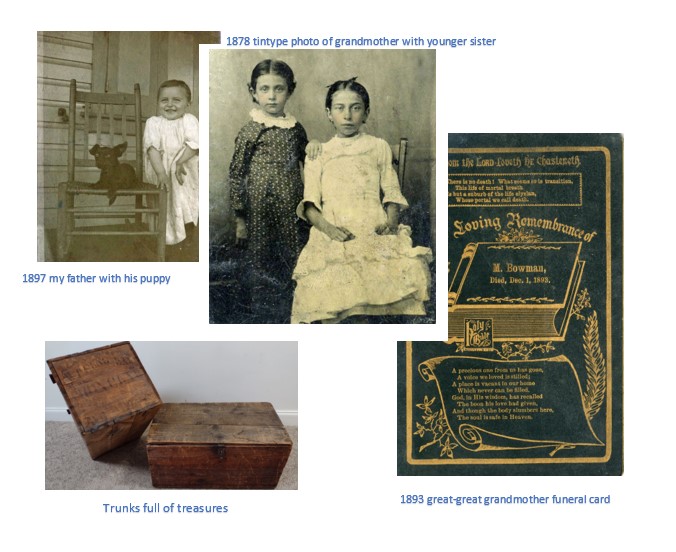
I was in charge of the care of my mother's house in Pennsylvania during the summers when she stayed at the ancestral home on the Chesapeake. One hot July day in 1997 early in my family history journey I was doing the weekly chores sorting mail and watering plants when I remembered a scene as a young girl talking to my father in my parent's basement when he pulled out an old photo of his puppy and one of his mother who had died in 1912.  It occurred to me that the photos were still in the house, and I poured over every box I could find without success.  Discouraged, I sat in Daddy's easy chair to think and spoke out loud my frustration and plea for guidance. Suddenly I had an idea for a hideaway in the basement, zoomed down the stairs, and within minutes had two old wooden trunks filled with documents, photos, jewelry, locks of hair, tin types, albums, newspapers, and more.  I was crying so hard that when I called my mother in Maryland I couldn't make myself understood and frightened her.  It took some time to convince her they were tears of joy.


Inside the wooden box were documents from the family including a legal-size sheet that described a 1920 family reunion of the Eisenberg/Jones family.[1]  It gave some history that led me to research our connection, and all at once I was related to a family that settled in Pennsylvania before William Penn! I spent the summer learning all about "New Sweden" along the Delaware River that was settled starting in 1638. On 27 September 1997, the descendants of the Swedish colonists held several events in Pennsylvania and Delaware to celebrate their heritage. I attended the annual Mans Jones Day in Berks County at the house owned by one of my ancestors in 1701.[2]   The Historical Preservation Trust of Berks County had people dressed in colonial garb and I ate lunch in the nearby colonial tavern. The next day the state of Delaware sponsored the launch of a replica of a Swedish ship, the Kalmar Nyckel, which brought many of the Swedish colonists to America. It is to be the official "tall ship" of Delaware because the first landing of the original Kalmar Nyckel was near present-day Wilmington.[3] 


One of the most prized treasures coming from one of the wooden trunks was a letter. Dad's aunt Mary had written the letter to her uncle who was living in  Delaware County in 1895. The letter was a description of the birth of my dad who weighed ten pounds. His exhausted mother allowed her mother to choose the family name, Joseph. What a wonderful document this letter is! Many baby pictures and unlabeled family photos were also part of the trunk's treasures.[4]  


It is such a wonderful gift to be able to honor those who came before us and understand ourselves a little better as a result of getting to know them.  Knowing that sometimes we are lucky to stumble over artifacts to illuminate their lives makes the journey that much more special and aids in honoring our ancestors.


[1]. George E. Fry, "History of the Eisenberg-Jones Reunion," 15 July 1922. This legal size paper was stored in a wooden

trunk found in the home of Joseph R. Bowman, the grandson of Philip Eisenberg Heavner. Joseph was raised in Philip's 

home and inherited many family documents and photos when his mother, then grandparents died. Philip's wife 

Catherine attended several family reunions as shown in photos also found in the trunks. The 1922 document seems 

to be a brochure handed out at a family reunion.

"Eisenberg-Jones family record," digital image, Internet Archive (https://archive.org/details/eisenbergjonesfa00unse : 

accessed 16 July 2022); originally published by the Historical Committee of the Eisenberg-Jones Family Association, 

Philadelphia, 1923.


[2]"Mouns Jones House," database, Historic Preservation Trust of Berks County 

(http://historicpreservationtrust.org/historic-properties/morlatton-village/mouns-jones-house/ : accessed 16 July 2022).


[3]"Our History," database, Kalmar Nyckel (https://www.kalmarnyckel.org/our-history : accessed 16 July 2022).


[4]. Two wooden trunks holding various family papers and photos, ca. 1880-30; privately held by Carol Bowman Kehler,

[ADDRESS FOR PRIVATE USE,] Pennsylvania, 1997. Found in the basement workshop of Joseph R. Bowman at his home in 

Bryn Mawr, Pennsylvania ca. 1997. Daughters Carol and Elizabeth cataloged, labeled when possible, and reviewed items.

Daughter Carol remembers her father viewing pictures of his mother in the workshop ca. 1965, probably taken out of the 

trunks to view.

Tuesday, July 12, 2022

Why create a family tree: The Psychology of Genealogy Research


Type the query “Psychology of Genealogy” into a search engine and scores of articles both scholarly journals and popular magazines appear as results. I had done such a search many years ago to prepare for a  basic family history lecture, but many new books and articles have been written about the topic in recent years spanning the globe.[1] The premise in the writings differs from work to work as some authors look at the psychology of the researchers and attempt to explain the attraction of family history, others look at the emotional benefits or problems attributed to the research of ancestors, sometimes the reference to Genealogy simply means a lineal history of a subject as seen in new articles that have appeared in the past decade that speak to Academic Genealogy.

Intellectual or Academic Genealogy is now used in various disciplines to trace the links from one scholar to another back in time often concentrating on the study of mentors for graduate degrees. A contemporary researcher in any discipline is thought to be influenced by his academic opportunities and mentors who in turn were influenced by their teachers that can be depicted in a pedigree form which allows evaluation of the credibility of works produced and bias of contemporary scholars.[2]  If it is true that academic scholarship is influenced by the history of the researcher, it can be argued that the personality of an individual has been influenced by their ancestors. Whether genetics plays a greater role in human development or if it is believed that environment influences an individual to a larger degree, nature and nurture can both be studied in family history to develop a snapshot of the individuals under study since our ancestors influence their descendants could be passed on both through the genes determining health and eye color or the environment they created around their offspring which shaped personalities.

The descriptions in published works of the personality of family history researchers or what makes a genealogist tick are often based on feedback and study of serious historical researchers who love the various aspects of genealogy such as organizational charts and color-coded notebooks, detective work long into the night, curiosity about individuals and what influenced their lives, passion for documentation and source citations and continuing education in evolving research methods and best practices. These personality traits of course do not describe the vast majority of individuals who crave some basic ancestral facts or have a curiosity about their ethnicity or perhaps are searching for answers as a result of adoption questions but do not have the time, resources, or skill set to research their questions in depth. So, it is unreasonable to believe that there is a particular psychology to those who have family history questions.
©

It seems the emphasis in the Psychology of Genealogy should be not on what drives those to partake in what is often seen as a popular fad but instead, should be on the benefits or cautions to individuals who explore their ancestry. There are a few simple advantages to researchers creating family trees. In a world much separated by distance and busy schedules and most recently the pandemic, socialization takes place online between researchers working on a common family line. Long-lost extended family can reconnect. I had an unknown grandparent ancestry that took deep digging and hours of analysis to piece together, then a distant cousin met online sent me a large box of original family photos giving me the opportunity in middle age to see my ancestors on that line for the first time. The collaboration with newly discovered cousins is heartwarming as I discovered having tea in Devonshire, UK with a previously unknown cousin of my grandmother who took me on a car tour of the ancestral village after I connected with her friend online.

Priceless memories can be made including some with immediate family as my children each in turn traveled and researched with me on our shared family history. They trudged through cemeteries looking for names on headstones, sat in libraries and archives, and patiently listen to my latest findings. My daughter can remember the day I ran to her school to let her know she was related to Daniel Boone, she was there when the Kalmar Nyckel ship was launched 25 years ago in Delaware as a replica of the one on which her Colonial Swedish ancestors journeyed to North America, and the children were beside me when I touched the ancient wall in Germany where their ancestors were baptized. The shared experiences of travel, new cultures, and academic research made history come alive for each of us and I am so grateful for them beside me through the experience.

The mental stimulation of constructing a family puzzle with some stubborn pieces taking much effort to place in the big picture is as rewarding to fighting off aging as Sudoku or Crosswords. Family researchers find they must keep up with the latest innovations in technology to access records and sometimes need to utilize educational opportunities such as conferences or formal classes to understand research tools and analysis methods to break through brick walls in research.[3] Continuing education keeps minds sharp and gives new depths to interesting aspects of personality. New vocabulary is acquired and thought processes and communication skills can deepen.

Analytical Literature on family trees and their impact on health is abundant. Familial Health history is often required before medical treatment. Famously the family tree of Ernest Hemingway has been studied, researched, and depicted in detailed family charts showing the impact of the genetic ancestral connection to bipolar disease and suicide in his family.[4]  Sometimes the knowledge of family medical history allows patients to mitigate risk. Recent studies in Emotional Genealogy and how the last few generations of ancestors influence contemporary individuals are important for mental health practitioners to review in their efforts to give counseling to suffering patients.[5]

It is easy to imagine the good feelings generated in individuals who find their place in a story of a family. A sense of belonging could result and personal links to past and future would be felt by those discovering their ancestry. Sometimes there are sad, unexpected, or scary tales within a family history that can be jolting. There are ancestors who inspire pride and some for which we feel shame, but their victories or sins are not ours. Family history should not be ancestor worship, but the discovery of the cultures and historical circumstances that shaped those who raised us who were in turn raised by humans who had significant stories.

Decisions made along the way by ancestors in a family tale impact the present from the choice to move to an urban or rural area, financial and occupational selections, choice of spouse, or abandonment of children can all change the opportunities and feelings of self-worth for contemporary individuals. Some emotional turmoil follows them into adulthood and changes the way they respond to their own descendants. Understanding the stories of those who came before sometimes gives room for compassion for family members who suffered or inspiration by trials they suffered and may have overcome. It can aid in us feeling I am not in this alone nor am I the only one who has dealt with joy or grief.

I knew a person who was universally thought to be negative and stern. The cold personality put a damper on social gatherings and was stressful. A short time before death they reached out to me and explained the abandonment by a parent and abuse by another family member caused mistrust as a young person which was never resolved. Knowing the story allowed for forgiveness and understanding. Another acquaintance lost their house in the depression and their car was put up on blocks by the bank, they lost two businesses and then their spouse died young. Empathy for those touched by such events goes a long way to an appreciation of the blessings we do have or may give us space to forgive ourselves for regretted decisions.

Perhaps unique to a few genealogists, there is a passion for the past and a feeling of responsibility to honor those who came before even outside our own immediate family. Sometimes it is a touchstone to reflect on their impact on our lives, sometimes they have no family to remember them. Often when I lose a friend I put together a basic family tree to teach me something about how and where they were raised, the occupations of the family members, where they went to school, and what activities interested them. Reading obituaries, leafing through online yearbooks, looking at extended family online trees, and finding old photos brings them closer to me, gives me an understanding of the robust lives they led, allows for grieving then healing, and celebrates their lives.

Since May 2000 DNA test kits have been publicly available and have increased in accuracy and types of genetic testing. Various DNA test results at multiple companies together with analysis of overlaps in family trees have resulted in startling results, sometimes just having a test result confirm what you believed about your family connections creates a wow moment that is empowering. Increasingly stories of unexpected results end in emotional trauma for testers.[6] But the most heart welling consequence of the widespread DNA testing seems to be the profound realization that we are all related.... all humans share 99.9% identical genetic makeup.[7] The difference is 0.1%...

One of my genealogy methodology mentors is the genetic genealogist, Diahan Southard who is a fantastic scientist and expert family historian who cheerleads her students through the maze of DNA analysis. She taught middle school students in Atlanta about their DNA test results to promote racial healing as she showed the young people how related they were, how diverse their backgrounds, and yet share identity with all those around us.[8] A 2016 study by a travel company to promote worldwide cultural acceptance followed 67 diverse individuals who found they had much in common.[9] Genealogy and DNA studies can be used by devoted researchers to make a difference in the world, promoting kindness and racial healing.  

Although anyone regardless of their passions, gifts and occupation can give back and support others, I have seen the work of “genealogy angels” over the past few decades unselfishly guide those who have holes in their hearts from empty spaces on their family trees.[10] Hugs from library staff at the Family History Library in Salt Lake City when a brick wall comes down, Archivists who photocopy and mail birth or death records on their own time and cost, online volunteers who find the long-lost siblings separated by adoption all done with energy and joy that celebrates the newly found connections for others is heart swelling. I sat quietly in a small German town archive beside my youngest son attempting to read old German Script and struggling to discern the location of an ancestral home. The archivist realized my dilemma and in broken English explained he would escort us to the spot which was a few blocks away. My broken German did not do justice to my gratitude for his kindness. Often family historians sense profound moments in others and share willingly in celebration of connection.

 I have a bad habit of watching sappy Hallmark movies and keep the box of tissues nearby, but I also use those to stem the tide of tears when I watch Henry Louis Gates, Jr. interact with guests on his “Finding Your Roots” PBS series.[11] With a gentle spirit, he gifts family ties to those seeking a sense of their heritage, good or bad and they are profoundly changed. Not all people need the journey into their past as they find their lives fulfilled with busy schedules and a good support system in the present. But many find at least some time in their lives the need for connection to their family history which may provide comfort or answers, forgiveness or understanding of those in the past and who we are today.


[1] Susan Moore, Doreen Rosenthal, Rebecca Robinson, The Psychology of Family History (Abingdon, UK: Routledge, 2020). Australian authors S. Moore a social psychologist and professor, D. Rosenthal a developmental social psychologist, and R. Robinson a computer scientist and theologian together study why genealogists research and the effect on self-identity.

Susan M Moore, “How Ancestor Research Affects Self-Understanding and Well-Being,” Multidisciplinary Digital Publishing Institute, Basel, Switzerland (https://www.mdpi.com/2313-5778/6/1/20/htm :  accessed 10 July 2022); original publication, Genealogy, Vol. 6, no. 1:20, published 1 March 2022. The author references scholarly articles and journals.

Jurai Darongkamas and Louise Lorenc, "Going Back to Our Roots," The Psychologist, publication of the British Psychological Society (https://thepsychologist.bps.org.uk/volume-21/edition-12/going-back-our-roots : accessed 7 July 2022), Vol. 21, December 2008, pp. 1022-1025. The UK.

Paula Nicholson, Genealogy, Psychology, and Identity: Tales from a family tree (1st ed.) (London: Routledge, 2016). Explores psychosocial factors run across generations.

Nathan H. Lents, "The Meaning and Meaninglessness of Genealogy," Psychology Today (https://www.psychologytoday.com/us/blog/beastly-behavior/201801/the-meaning-and-meaninglessness-genealogy  : accessed 7 July 2022), Online U.S. magazine post 29 January 2018.

Penny Walters, Ph.D., The Psychology of Searching (Author: United Kingdom, 2020); Search my Past (https://www.searchmypast.co.uk/ : accessed 22 August 2022).

[2] Hortense Le Ferrand,  “Academic Genealogy to Follow the Evolution of Materials Research,” Cambridge University (https://www.cambridge.org/core/journals/mrs-bulletin/article/academic-genealogy-to-follow-the-evolution-of-materials-research/06462C93B217E8A8D377A1A3013A5FB9 : accessed 8 July 2022) Materials Research Society at Cambridge University Press, MRS Bulletin 45, no. 8 (2020): 675–76. doi:10.1557/mrs.2020.228.

[3] Arnon Hershkovitz and Sharon Hardof-Jaffe, "Genealogy as a lifelong learning endeavor," Leisure/loisir 41, no. 4 (2017): 535-560. Canadian researchers analysis of lifelong learning in genealogy.

[4] Dean F. Mackinnon, M.D., “A family tree filled with mental illness,” journal article, National Library of Medicine (https://www.ncbi.nlm.nih.gov/pmc/articles/PMC3574759/ : accessed 9 July 2022), Cerebrum, 30 May 2012. A physician review of the family research by Victoria Costello: a lethal inheritance: a mother uncovers the science behind three generations of mental illness.

Neel Burton, M.D., “The Many Names of Bipolar Disorder,” online article, Psychology Today (https://www.psychologytoday.com/ie/blog/hide-and-seek/201509/the-many-names-bipolar-disorder : accessed 8 July 2022), posted 16 September 2015. While this example is from a popular magazine, many scholarly peer-reviewed journal articles can be found on this subject with in-depth analysis.

[5] Judith Fein, “What is Emotional Genealogy?,” website, Emotional Genealogy (emotionalgenealogy.org : accessed 9 July 2022). Also described by the author “What is your Emotional Genealogy?,” online article, Psychology Today (https://www.psychologytoday.com/us/blog/life-is-trip/201401/what-is-your-emotional-genealogy : accessed 9 July 2022), posted 26 January 2014.

Helen Parker-Drabble, “How key psychological theories can enrich our understanding of our ancestors and help improve mental health for present and future generations: A family historian’s perspective,” Genealogy, 6: 4, viewed at Google Scholar (https://scholar.google.com/)

[6] David R. Topher, Ph.D., MS-HPed, “Genealogy testing: Prepare for the emotional reaction, blog post, Harvard (https://www.health.harvard.edu/blog/genealogy-testing-prepare-for-the-emotional-reaction-2018060613990 : accessed 9 July 2022), posted 6 June 2018.

Library of Congress (https://guides.loc.gov/family-secrets : accessed 9 July 2022).

[7] James F. Crow, “Unequal by Nature: A Geneticist’s Perspective on Human Differences,” Daedalus 131, no. 1 (2002): 81–88; JSTOR (http://www.jstor.org/stable/20027739 : accessed 10 July 2022).

[8] Diahan Southard, “DNA Ethnicity Results Connect Us, Not Divide Us,” undated Blogpost, your DNA Guide (https://www.yourdnaguide.com/ydgblog/dna-ethnicity-results-can-connect-not-divide-us : accessed 8 July 2022).

[9] Jeppe Rønde, director "Momondo-the DNA Journey," video, Momondo-Let’s Open our World (https://www.youtube.com/watch?v=tyaEQEmt5ls : accessed 7 July 2022), video post 2 June 2016. 67 culturally diverse individuals find common ground with their DNA results.

[10] Oscar Schwartz, “DNA search angels: the Facebook 'detectives' who help reunite families,” online news article, The Guardian (https://www.theguardian.com/lifeandstyle/2019/apr/29/dna-search-angels-adoption-facebook-detectives-reunite-families : accessed 9 July 2022), 29 April 2019 from New York City.

[11] “Finding Your Roots,” database, Public Broadcast System (https://www.pbs.org/weta/finding-your-roots/about/about-series : accessed 9 July 2022). “Harvard scholar Henry Louis Gates, Jr….stimulating a national conversation about identity with humor, wisdom, and compassion.”


Thursday, June 16, 2022

Memorial to honor an old friend

We seemed an unlikely pair of friends. Dionisio was born in Panama, lived in the city, was a gentle giant, six feet tall, and built like a linebacker but with a heart given easily to others. Our backgrounds were so culturally different in many ways it is a miracle that we became close friends, but I can't remember any part of my college and early career years without him entwined in my memory. Starting with the first day of classes, Dio sprinkled magic dust on my academic experience with his enthusiasm for life, positive energy, and a way of orchestrating groups of diverse young students into worthwhile projects.  I experienced student teaching with joyful energy because of his cheerleading and am forever grateful for having him in my life.

One very cold January night was my second evening as a dorm student after a semester commuting to school and I was anxious.  I had fitful sleep the night before never having had a roommate and tossing on a strange squeaky bed. I worried that no rest would make studying difficult, so Dio prodded and pushed me to discover that I slept well at home with stuffed animals.  Nothing would do but we bundled up into my car and took off to the mall. Dio stood in Woolworths with me and helped squish teddy bears to try to find the softest one. What a sight we must have made! It began to snow while we were in the store and the roads were slick. The ride home was treacherous and took forever. That silly soft bear did help me sleep, but I am not sure it was worth risking our lives in a snowstorm.

I treasure the notes and photos left by his presence in my life.  He got me through study groups in the local diner sipping chocolate sodas and stealing each other's fries, my romantic heartbreaks, the first few years of teaching school and I can still hear Dio cheering next to me in the stands while our friends played an intermural basketball game. Our relationship will continue to inspire and comfort me as I remember him with admiration for his positive energy and gratitude for his time spent with a young unsophisticated girl many years ago.

In his last birthday card to me was a purple bookmark with a quote from John 14:27...."Let not your heart be troubled, neither let it be afraid."  I cherish the privilege of being his friend and took time recently to work on his family history and a Find a Grave Memorial to honor his memory and his wonderful parents, all gone from us but who touched our lives in profound ways.

https://www.findagrave.com/memorial/134803702/dioniso-octavio-dennis


Thursday, May 26, 2022

A Family Memory and Property History Merge


At the little green cabin on Soda Butte Creek, the sunlight filters through the swaying branches of the tall lodgepole pines as the sparkles of sunlight bounce off fast-moving currents of the creek and peek through the greenery. The bushes and trees hide chipmunks and squirrels and the tiny fawn who visits in the evenings and the mother Fox with new kits.  Republic Mountain with waterfalls from melting snow can be seen to the south across the creek from the big picture window in the cabin.  Inside, hanging on the wooden logs, a hand-painted wolf dreamcatcher made by my daughter guards the front door which sets the mood for reflection. The photographs on the walls taken by our family show wildlife viewed over the years. There is a crackling fire in the wood stove and a small pile of the many logs that my oldest son cut when he visited in May. I cozy up to a blanket that my youngest son gave us last July when he visited. This is a family place.

Although not an outdoor person by nature, it is a spiritual experience to view the jagged snow-covered mountain peaks and wide expanses of green sliced by rapid rivers, smell the sagebrush as bison tramp through the blue-green bushes, and hear the sounds of eagles, osprey, and falcons soaring above.  There is scenery and wildlife to appreciate at every turn. From the waterfalls at Artist Point to the confluence of Lamar River and Soda Butte Creek the vistas are breathtaking. There are geothermal features at Mammoth Hot Springs and the Dragon’s cave just beyond Hayden Valley. Wild life at day break in the spring can be seen nursing newborns or hunting for food. Wolf pups go tumbling down the hillside near their den while bison calves hop in play battles, grizzly mothers climb trees with their cubs and a mother badger pushes her young towards their den to avoid aggressive tourists and we capture it all on film.  The fuchsia pink fireweed, the watermelon red paintbrush, and the lavender lupine add spectacular color along with gold and cream wildflowers at every turn.  We find moose in the willows and coyotes running through sage, beaver dams that flood the front yards of friends in Silver Gate and adorable pikas hiding in rock formations, and bald eagles that survey Slough Creek.  The drama of grizzly and wolf and coyote struggling to survive amidst herds of bison and pronghorn play out on the valley floor along the Lamar River bring us close to nature and allow us to share with each other once-in-a-lifetime moments.

The land between Silver Gate and Cooke city has witnessed various travelers through the centuries: native American hunting parties, miners panning for gold, real estate investors and developers, and those who love the flora and fauna of this private stretch of woodland within the Custer Gallatin National Forest. The history of the community starts with the Native American tribes pushing back against western expansion and the discovery of valuable ores in the region.  The Crow nation had several treaties with the U.S. government that were renegotiated over many years as white settlers entered the area.  In July 1870 gold was found near Cooke City, and although the ore was located on Crow land, prospectors flocked to the area and began to call for easier access to the remote mountain region and the ability to stake claims to the land. By 1882 the Crow lost the mining region and were pushed east and the mining lands northeast of Yellowstone National park were available for settlement.

A small group of wealthy investors from Minnesota created the Cooke Placer Mining Company in 1890 and hired miners to work the claim by panning for gold in Soda Butte Creek.  The company was never profitable and by 1937 had ceased operation.  Almost from the moment of the discovery of ore in the Cooke City area, battles between land rights for Native Americans against claims by prospectors along with battles between naturalists versus the operators of mines that polluted streams and groundwater raged in the local press. Professor C. G. Swallow a geologist and mine inspector wrote in 1889 in support of rail lines and transit to the area for support of Cooke City mining. In 1893 the superintendent of Yellowstone National Park submitted a report stating the mines in Cooke City did not have robust outputs of ore and the 100 inhabitants of the town were not worth a rail line or better transit. Experts on both sides of each issue can be found in the Montana newspapers before 1900 explaining their positions. 

During the 1930s the area began to develop for tourists to Yellowstone. Hotels were built in Silver Gate and a real estate agent together with a lawyer ordered land platting of small sections along the road from the Northeast entrance to Yellowstone. By 1970 a community between Silver Gate and Cooke City had tracts of land for sale.  Basting Tracts was created by a descendant of an original Cooke Placer Mining shareholder.  One of the first lots was purchased by a builder from Missouri who built the little green cabin along Soda Butte creek and his family cherished the spot during warm seasons for many years. The bison still visit along with the fox and moose and as the current caretakers of the land, we appreciate the vista and remember those who came before.

Bison in the cabin front yard

Update 13 June 2022, the devastating flooding that occurred along the Yellowstone River overnight due to melting snow and savage rainstorms caused much damage to the area between Gardiner to Cooke City and beyond isolating those communities, damaging bridges and roadways which forced the closure of the northern section of Yellowstone and will cancel the plans this summer of many wildlife and nature tourists who expected to visit and make commercial enterprises around the park difficult.  The little green cabin stands, but many residents are hurting at this time.  Our thoughts and prayers are with them during this difficult time.


Wednesday, December 30, 2020

The Invincible Summer within us for 2021

 au milieu de l'hiver, j'apprenais enfin qu'il y avait en moi un été invincible

In the midst of strife I found there was within me, an invincible love.  In the midst of tears, I found there was within me an invincible smile.  In the midst of chaos I found there was within me an invincible calm.  In the depth of winter, I finally learned that within me, there lay an invincible summer.  And that makes me happy.  For it says that no matter how hard the world pushes against me, within me there's something stronger...  ~Albert Camus

How beautiful the notion that we have the power to walk through storms with calm and courage.  Albert Camus wrote his poetic words in 1952, several years prior to my own birth, but they resonate in 2020, the year of fear and turmoil for so many around the world.  May 2021 be a year of peace and light.

                                                                       Sunrise at Cedar Point


Saturday, December 26, 2020

Patience in genealogy Pays off

Nana and Granddad spread enthusiastic positive energy whenever they entered a room. They were so encouraging and kind that when a cousin married into their family, I adopted them as grandparents. In some small way to repay their kindness over the years, I used genealogy research to reconstruct their German roots ending in my visit to their European hometown where I took a picture of their ancestor's home and church. There was one line in their family trees that stayed empty on the pedigree chart. Granddad grew up longing to know something about his mother's family. His mother avoided the subject of her family and questions asked about ancestry were never answered. As an only child whose father died in WWII, Grandad's questions about family were important to fill the empty spaces. After his mother's death, we looked for clues for several decades hoping to find something in records or artifacts that would tell us where she came from. There was an old school book with a Virginia address inscribed on the front page, a story about her mother named Ruth, and several anecdotes about an old southern plantation that just didn't seem to fit anywhere in the ancestral picture.

Hired researchers, ordered documents, hours online and in archives pouring through records, we always hit brick walls. Suddenly last year Granddad remembered visiting a family in Baltimore on Southern Avenue that he thought might have been relatives. Having long ago run out of any other leads, we looked in census records to see what we could find. Only one family in that area matched the description, so in-depth research on the occupants of that home in Baltimore led to a woman named Ruth... Ruth was the great-great grandma we had been searching for, although it took some detective work to piece together the story. As one clue followed another leading to an online researcher who posted her family tree, collaboration through emails, and finally much anticipated DNA results proved the connection. After so many years of wondering about his roots, Granddad suddenly had live cousins and a robust family tree. At age 91 Granddad knew his mother's story at last bringing peace and forgiveness.

To be ready for the sudden clue it was imperative that we organized our many years of research. The long-lost memory reignited the search for Grandad's family, but the clues meant something as we pieced together the story bit by bit because we had outlined all the known facts over many years. We knew Granddad's mother spent time in the Norfolk, Virginia area from the address in her old textbook so when the Baltimore address led to a study of the family who lived there and we found an uncle who had lived in Norfolk we had a trail of clues to follow.


The uncle from Norfolk had married Ruth Lavinia. It was Ruth's second marriage and we eventually discovered that she had three daughters and a son from her first marriage who were put in an orphanage after her first husband left their home and divorced Ruth. The son died at the orphanage shortly after the children arrived in 1912, the oldest daughter lived until adulthood at the orphanage and workhouse, while another daughter was adopted.

Children's Home Log


It was the adopted daughter's descendants who submitted DNA testing and posted their family tree online which led to the orphanage records and showed the 4th child of Ruth, Granddad's mother, taken to the orphanage at age 5. The birthday and given name were exact and then we were able to trace forward through Norfolk and Baltimore records. Ruth had gone back to the orphanage looking for her children after almost ten years and her remarriage. Her son was dead, and one daughter was adopted so she took Granddad's mother to live with her in Norfolk.

The descendants of Ruth's adopted daughter shared the few recollections about the children's orphanage experience they could glean out of conversations over many years. Although reticent to talk about those years, she said it was cold the day the children arrived at the facility and the siblings were separated upon arrival. The work of cleaning and washing was difficult for the children and there was no love in the place. Those few memories are sobering to all of Ruth's descendants as we remember those four children with breaking hearts.

Children's Home

Without the kindness of genealogy collaboration with strangers met online, the story of Ruth and her children might never have made its way to Granddad who needed to know the bleakness of his mother's childhood in order to fully forgive her fabrications and evasions in questions about family history. Patience this time paid off along with lots of luck, a twinkling of memory, a family hundreds of miles away who took DNA tests and were willing to share their stories, and hours of careful research in documents that fit together with years of organized clues. Patience in genealogy sometimes pays off.

Tuesday, September 17, 2019

Part of Me: How DNA helps solve the mystery


A part of me was missing. There was an empty branch on the family tree hanging on my office wall. I've done genealogy research for 30 years, but the beautiful ancestral document looked lopsided each time I passed by.  My mother was missing a grandfather. 

This was more than a search to fill in the blanks on a paper pedigree, it was the research I needed to do to fulfill a promise I made in honor of my mother and her father who both missed out on important people in their lives. That loss changed them, made them different than they would have been with a complete family and that difference was passed down through generations who may not have realized the empty space but were missing a part of a complete family. That loss has consequences, less confidence and sense of self...

The finding of names and dates of ancestors does not make up for not knowing them in life, but it helps complete the circle. We know better where the parts of our inner selves came from and who helped make up our DNA, where we got our blue eyes and crooked smiles.

For more than 20 years I read every document on Illinois genealogy and Scots-Irish ancestry I could find. In the early days, I mailed letters asking for information and waited by the mailbox for replies. I traveled to repositories and called every historical society, Church, or governmental agency that might have any information that would lead to the Lost ancestor. With the advent of the internet, I spent hours in the middle of the night searching and then emailing and then... DNA...


Running to the post office with the test kit and waiting for the day the answer would come with who we were related to was not the reality. It took several years of learning the methodology of DNA analysis and contacting distant cousins with whom I shared ancestry, building family trees, and comparing them to try to find the missing link.

And then last Saturday like a wave speeding towards the shore and raising up out of the ocean about to crash onto the sand- I could feel it about to happen. Those last few minutes of anticipation before I turned the final page and years of research and analysis of reams of data crashed all at once.

My mother has a grandfather. It's too late for any change in her life. The ripples throughout the family generations are already in motion and truthfully just knowing a name and a date would not have given my grandfather a Dad, but now I know where he got his blue eyes which he passed on to his daughter and then I passed to my oldest son. And we know we are related to Daniel Boone and many Illinois pioneers and Scots-Irish ancestors who will fill in the blanks of my beautiful family tree. If it weren't for their lives,  there wouldn't be me. I am no longer missing a part of me.